The Palio
Twice a year, ten horses run bareback around the Piazza del Campo on packed tufo laid over the stone, for contrade that have held the ritual for centuries — and it is genuinely contested.
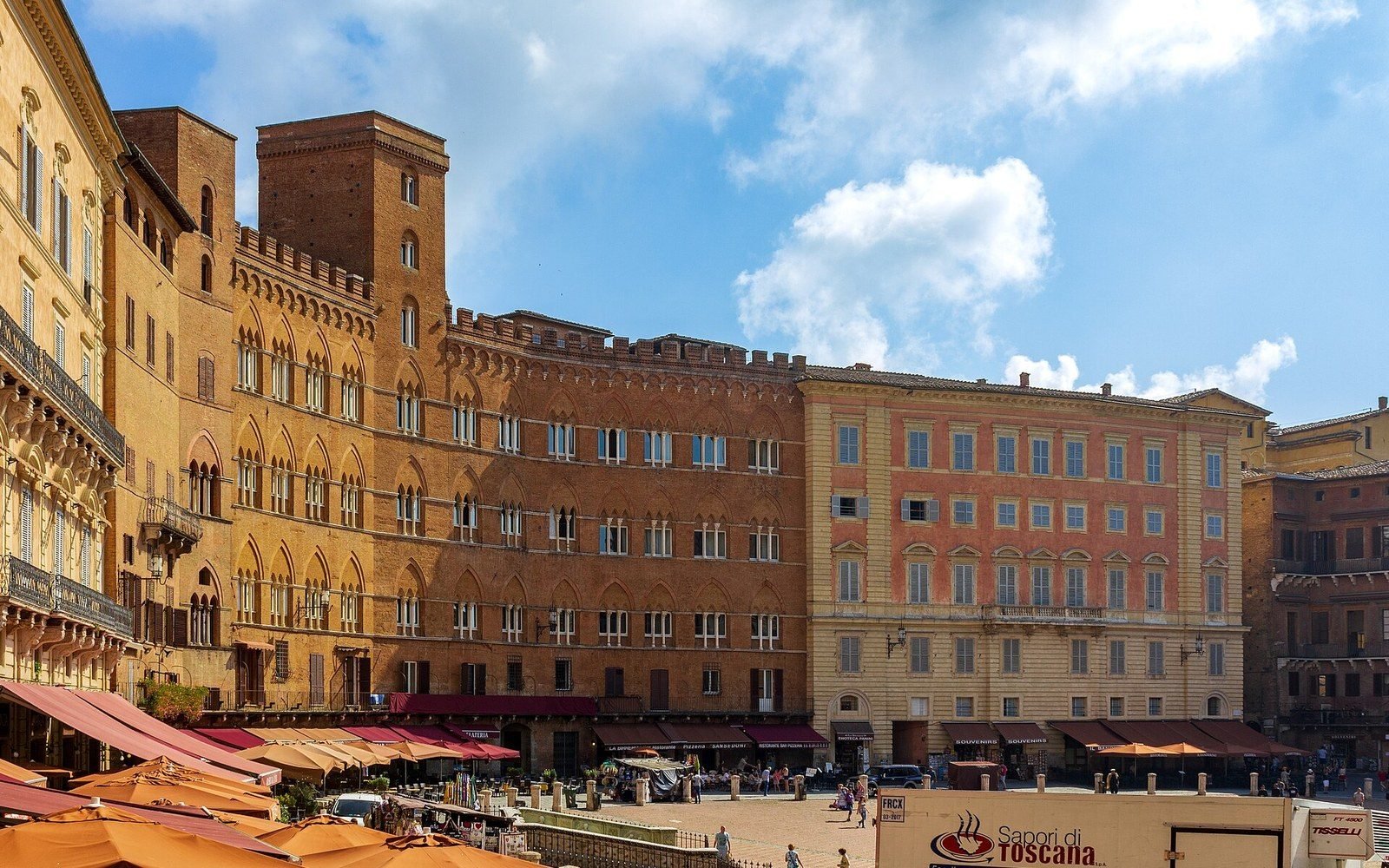
Photo: Piazza del Campo 2014 01 · Wikimedia Commons
Ten horses, ten riders, no saddles — and a result that can stand or fall on a deal made the night before.
A Race Held in a Square
Twice a year, on 2 July and 16 August, the Piazza del Campo in Siena, comune di Siena, fills with compacted tufo — the soft volcanic earth laid over the stone paving to give horses grip on a track that is otherwise lethal — and ten of the city's seventeen contrade, or city wards, run a bareback race of roughly ninety seconds that determines, at least in the minds of those who live it, something close to the meaning of life. The Palio di Siena is not a spectacle put on for an audience. The audience is incidental. The race is conducted by the contrade for the contrade, and the distinction matters.
The Campo itself is not a track that happens to sit in a city. It is a medieval shell-shaped piazza, gently concave, with the fan of brick-and-stone paving replaced at its inner edge by three laps of dirt — and two corners, known as San Martino and Casato, that compress the field so violently that falls are not unusual, they are expected. The tufo is trucked in, laid and packed in the days before each race, and it transforms the piazza into something that is neither square nor circuit but somewhere in between. The track runs 333 metres per lap; three laps complete the race.
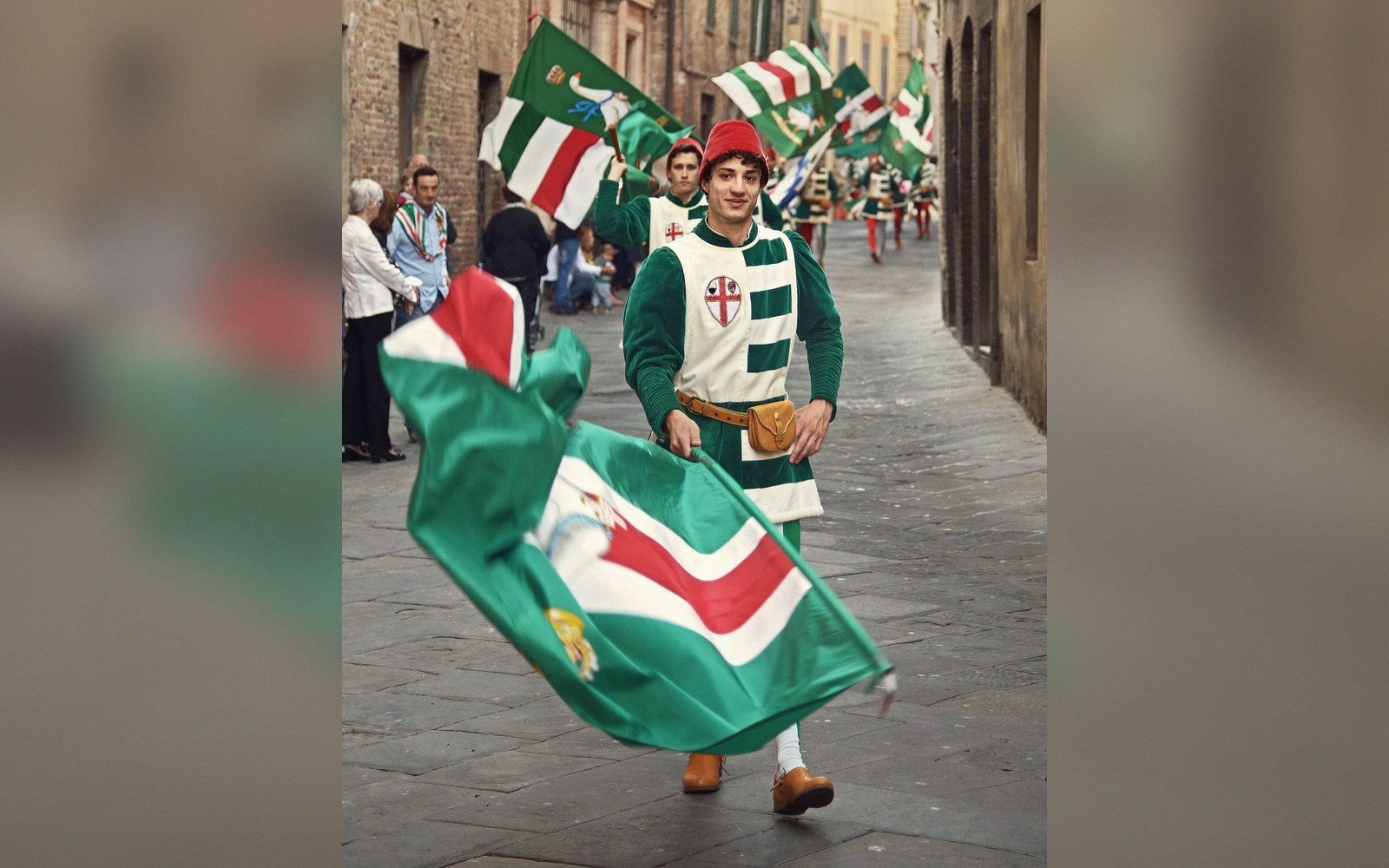
A contrada is a city ward with its own colours, chapel and membership — the race is between wards, not stables.
Photo: The procession of the Noble Contrada "Oca (Goose)". Siena, Italy · Wikimedia Commons
Horses, Riders and the Assignment of Both
The horses assigned to the Palio are not a specialist breed. They are sourced from across Italy, evaluated for temperament and soundness, and selected by a municipal commission in the days before the race. What matters is that they be manageable on the track — compact, reasonably steady and able to hold a line under bareback conditions in a crowd of nine other animals. Thoroughbred blood is common, but so are crossbreeds. The assignment of horses to contrade is made by public lot, and this is important: a contrada does not choose its horse, cannot influence the draw, and must work with what it receives in the days that remain before the race.
Riders are another matter. The fantini, as the jockeys are known, are professionals hired by the contrade and paid to win — or, sometimes, to ensure that a rival contrada does not. A fantino is not from Siena. He is an outsider, usually from Sardinia or the southern regions, contracted because he has the skill and the nerve to ride bareback at speed around San Martino without saddle, stirrups or reins beyond a single short cord. The relationship between a fantino and his contrada is transactional, and it has always been so; the records of payments to riders go back centuries.
A horse that throws its rider and completes the race riderless — scosso in Sienese usage — can still win for its contrada. The win belongs to the horse, not the man, and a riderless winner is fully valid. This rule alone says something essential about the nature of the event: the animal is the protagonist, and the rider is, at some level, optional.
The Contrade and What They Carry
The contrade are the structural fact on which everything else rests. There are seventeen of them — each with its own territory within the old city, its own colours, its own patron saint and its own chapel — and they have existed as functioning social bodies since at least the medieval period. Ten run in each Palio; the seven that did not run the previous race of that date are guaranteed a place, and the remaining three are drawn by lot from those eligible.
Rivalry between contrade is not theatrical. It is historical, sometimes traceable to specific disputes of the fourteenth or fifteenth century, and it is transmitted intact through generations of membership that begins at birth. A person born in the territory of the Aquila, or the Tartuca, or the Lupa, belongs to that contrada for life. There is no application, no joining, no exit. The contrada holds baptisms, funerals and dinners; it maintains its own museum and its own horse stable in the months around the Palio. The race is the most visible event in a civic life that runs year-round and is entirely self-organised.
The tufo strip is packed over the brick paving of the Piazza del Campo, used for two days of racing, then removed.
Photo: Piazza del Campo 2014 01 · Wikimedia Commons
The prize — the palio from which the race takes its name — is a painted banner, silk, depicting the Virgin Mary. It has no monetary value. Its value is entirely symbolic, which is also why it matters so much. Winning contrade celebrate for days. Losing contrade, particularly those that lose through a betrayal by their fantino, carry the grievance forward for years.
What Is Genuinely Contested
The Palio is also a subject of serious, ongoing dispute, and any account that omits this is incomplete. The central criticism concerns animal welfare. The race conditions — three fast laps on a tight banked circuit, bareback, in a packed field — carry a real risk of falls and injury to horses. Several horses have died in the event or its preparatory trial heats over the decades, and the numbers are documented by animal welfare organisations including the Italian National Animal Protection Authority ↗. Critics argue that the structural conditions of the race make some level of horse injury statistically certain, and that no tradition justifies it.
Defenders of the Palio argue that the horses are selected and examined by veterinarians, that the track conditions are engineered to reduce risk, and that the culture of the contrade imposes its own accountability: a horse that is injured is an animal that belongs, for that Palio, to the contrada, and the shame of mishandling it is real. This argument does not satisfy the critics, and the criticism has not diminished with time. The municipal administration of Siena has made incremental changes to the rules governing track design and veterinary oversight, but the race continues in its essential form.
Chronology of the race days
Chronology of the race days
- 2 JulyPalio di Provenzano: run in honour of the Provenzano Madonna
- 16 AugustPalio di Agosto: run in honour of the Assumption; banner brought to the Duomo
- Preparatory trial heatsrun on the days immediately before each race
- Horse assignmentby public lot in the days before the race; contrade have no influence on the draw
There is also a secondary debate — quieter, but present in Italian sports writing — about the deals struck between fantini in the days and nights before the race. Negotiation between riders, on behalf of rival or allied contrade, is not against the rules. It is, in a sense, part of the game. A fantino may agree to obstruct another rider, to pull his horse on a corner, to let a particular contrada through. These agreements are not always honoured; a fantino who breaks a deal is not prosecuted, only remembered. The civic intelligence of Siena stores these betrayals with the same precision it stores anything else.
The Ritual Before and After
The race is preceded by a procession of extraordinary formality — the corteo storico — in which hundreds of participants in medieval costume carry the banners of each contrada and the historic standard of the Comune di Siena through the Campo. The ceremony has been documented since at least the seventeenth century and is performed without variation. It is not pageant in the sense of entertainment; it is a statement of civic continuity.
After the race, the winning contrada carries its banner and its horse into the church of the Provenzano (for the July Palio) or the Duomo (for the August Palio), and the celebration extends into the night and the following days. The horse is a guest at the victory dinner. It has been so for as long as anyone has kept records, and the tradition is not ironic. In the logic of the Palio, the horse won, and the horse is thanked.
Read next