The Track
The Piazza del Campo is not a racecourse — it is a medieval square that becomes one twice a year
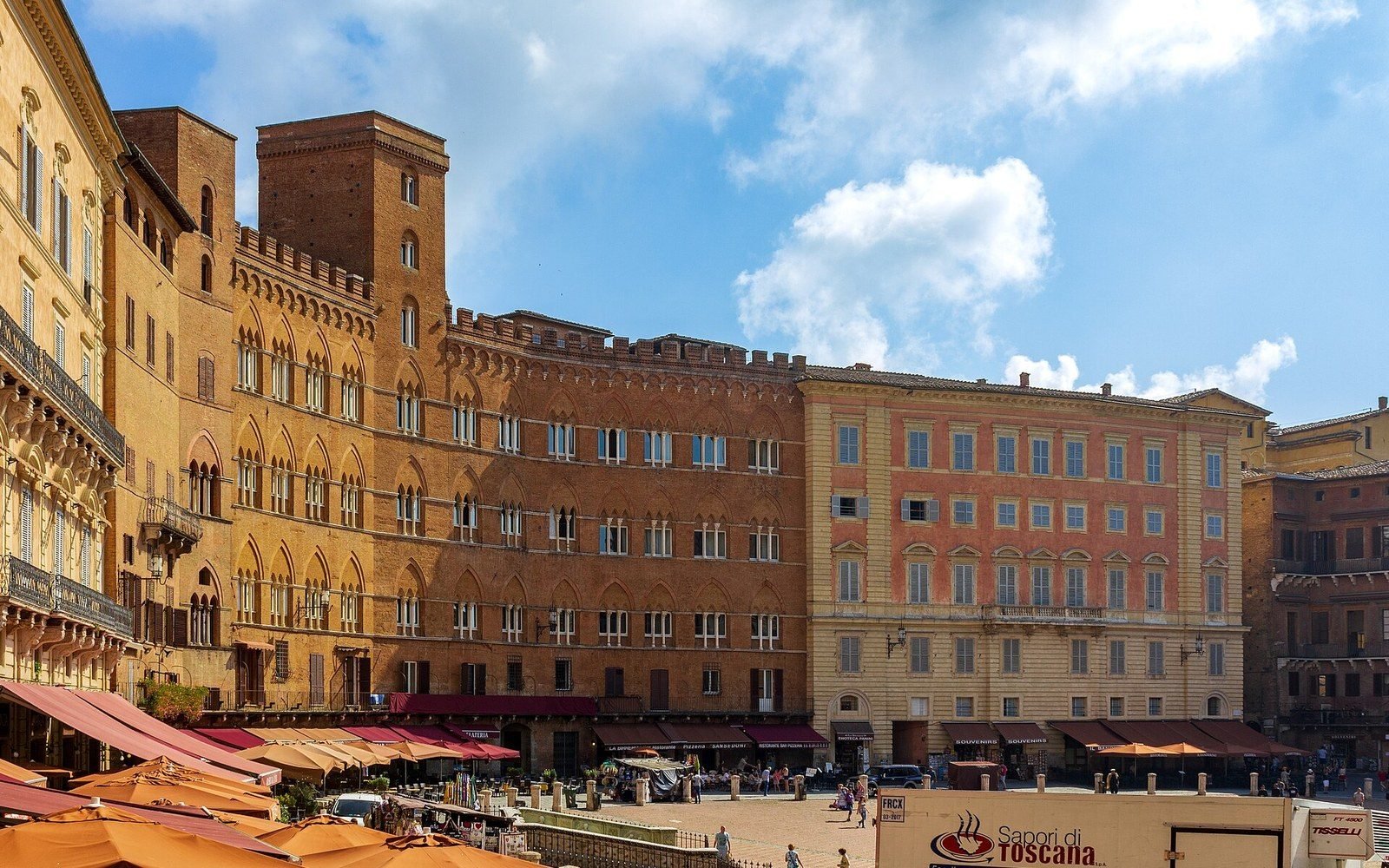
Photo: Piazza del Campo 2014 01 · Wikimedia Commons
The Piazza del Campo in Siena (comune di Siena, Tuscany) is one of the most recognisable public spaces in Europe, a broad fan of brick paving sloping gently toward a central drain. Its shell shape is not an architect's whim but the consequence of geology: the piazza sits at the confluence of three hills, and the ground simply falls that way. For most of the year, it is a gathering place. For the Palio di Siena, it is a racetrack, and the distinction between those two uses explains almost everything about how the race is run.
Tufo, corners and the architecture of danger
In the weeks before each race — run on 2 July and 16 August — the outer ring of the campo is transformed. A layer of tufo (the soft, compressed volcanic earth used as a racing surface) is packed over the brick paving to a depth sufficient to give the horses grip and some protection in a fall. This strip follows the perimeter walls of the square, roughly three metres wide at its narrowest, creating an uneven oval that is anything but smooth. The total circuit is around 333 metres, completed three times per race.
Siena sits inland on the tufo hills; the square that becomes the track is at the centre of the city.
Geometry: real coordinates, projected
Two sections concentrate almost all the risk. The corner at San Martino, on the southern curve, is the sharpest bend on the course and drops away on the outside — horses approach it fast after the longest straight and must negotiate the turn on a surface that packs differently each year depending on the summer heat. The corner at Casato presents a different problem: it arrives almost immediately after the starting rope drops, before the field has sorted itself. Both corners are padded against the outer walls before race day, and mattresses are positioned at the most exposed points, but the geometry of the track does not change. The walls of medieval buildings form the outer boundary, and no amount of preparation makes San Martino a straightforward turn.
The inner surface of the piazza — the famous herringbone brick paving — is not part of the race at all. Spectators stand on it. What they watch from the centre is a narrow, banked, sun-hardened strip running along the face of the buildings that enclose them, and what makes the Palio so visually compressed is precisely this: horse and rider are never far from a wall.
The track is laid, used for several days of trials and the race, then removed. The campo returns to brick. Nothing about the infrastructure is permanent except the buildings that make the course what it is.
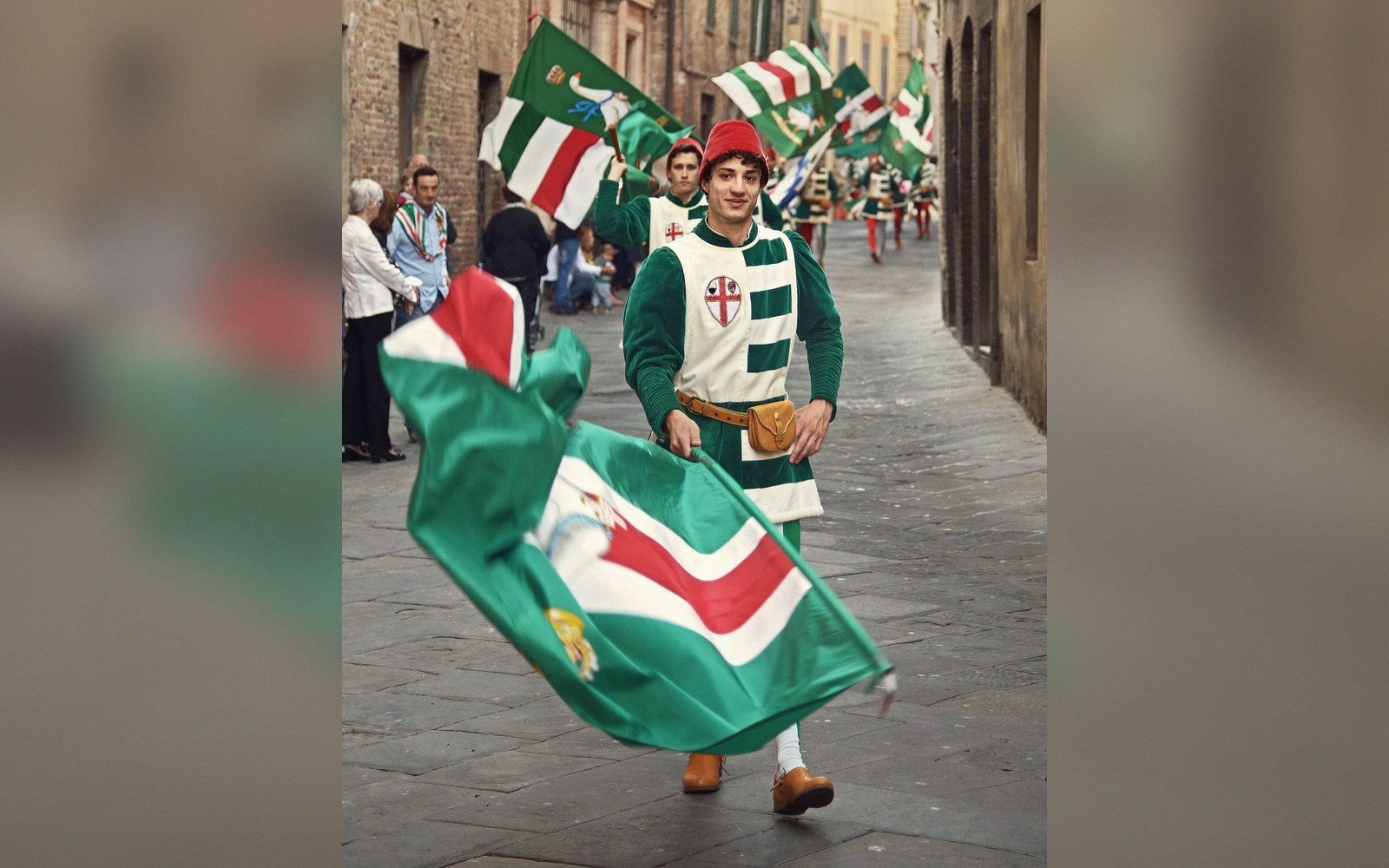
A contrada is a city ward with its own colours, chapel and membership — the race is between wards, not stables.
Photo: The procession of the Noble Contrada "Oca (Goose)". Siena, Italy · Wikimedia Commons
Read next