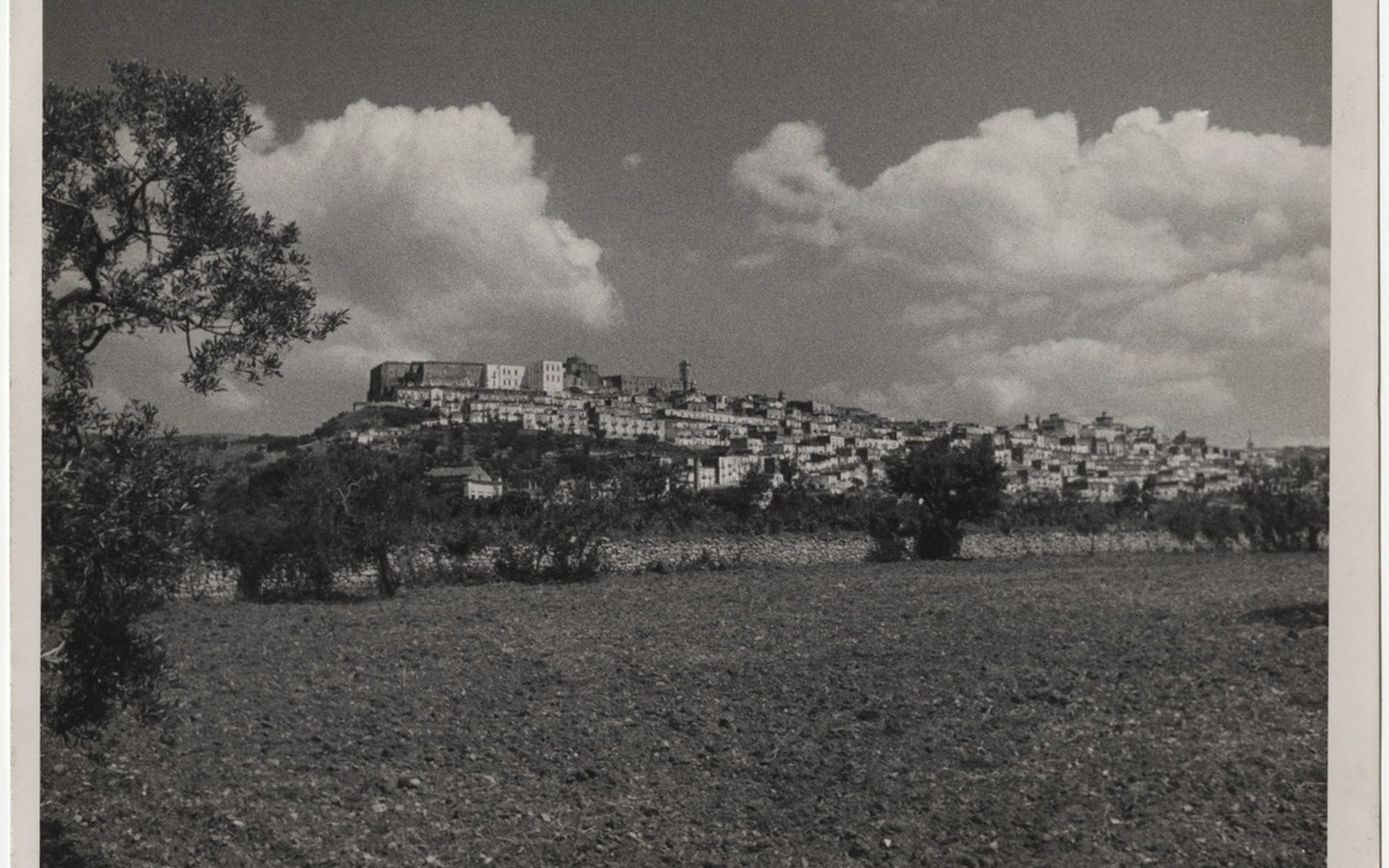
Photo: Photo View of Minervino Murge 1936 - Touring Club Italiano s06043-01 · Wikimedia Commons
The Murge is a karst plateau in Puglia, rising inland from the Adriatic coastal plain and running roughly between Bari and Taranto. It looks, from a distance, like flat grazing country. Up close, it is anything but.
Every place named in this entry is a comune or a region, and sits on the map at its real coordinates.
Geometry: real coordinates, projected
The bedrock is pale Cretaceous limestone — porous, fractured and barely covered by soil. Rain disappears almost immediately into fissures rather than forming rivers; the surface stays dry and hard even after wet winters. Grasses grow thin and sharp between outcrops, and the lame — shallow, bowl-shaped depressions that collect just enough earth for cultivation — break up the otherwise continuous rock. Woodland, where it survives, is low and scrubby: the gariga, a drought-adapted tangle of dwarf oak, wild pear and thorny shrub. This is not lush upland pasture. It is demanding, abrasive country, and it has shaped everything that grazes and works on it.
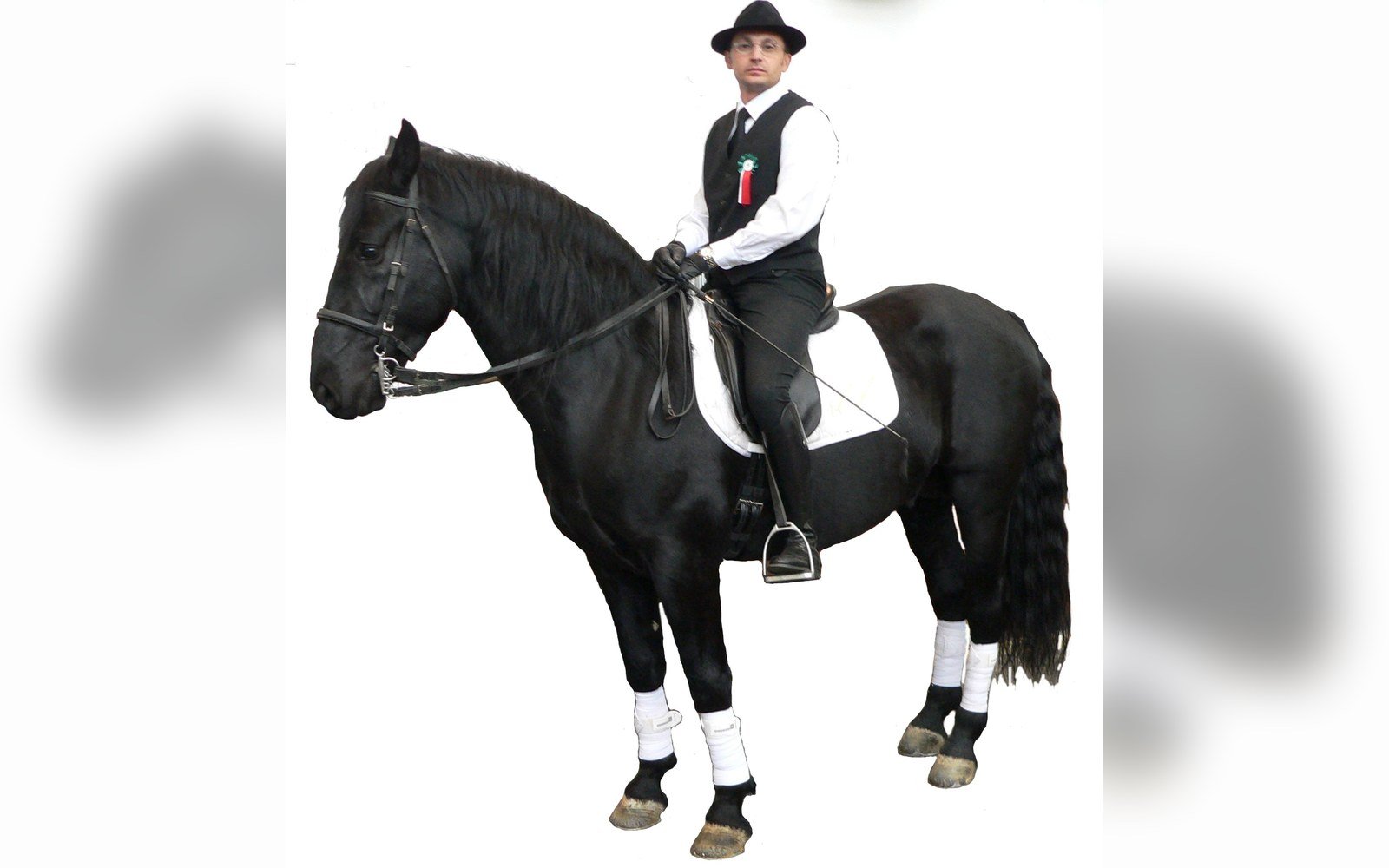
The Murgese is bred black or slate roan, on limestone pasture where the soil is thin and the water runs underground.
Photo: Murgese5 stehend Gang · Wikimedia Commons
The commune of Martina Franca, in the province of Taranto, sits near the plateau's southern edge and has lent its name to the registered stud territory for the Murgese horse. For centuries, breeding here was self-selecting: horses that could navigate broken limestone without going lame, carry weight over long distances between water sources and subsist on poor grazing simply lasted longer than horses that could not. The result is a compact, hard-hooved animal — short-cannoned and dense-boned — whose constitution mirrors the stinginess of the ground beneath it.
The plateau's elevation — rising to around 680 metres in the Alta Murgia — also means sharp temperature swings between summer and winter, adding another filter to any animal raised here. The Parco Nazionale dell'Alta Murgia ↗ now protects a significant area of the plateau's centre, preserving the open limestone scrubland that remains the reference habitat for the breed.
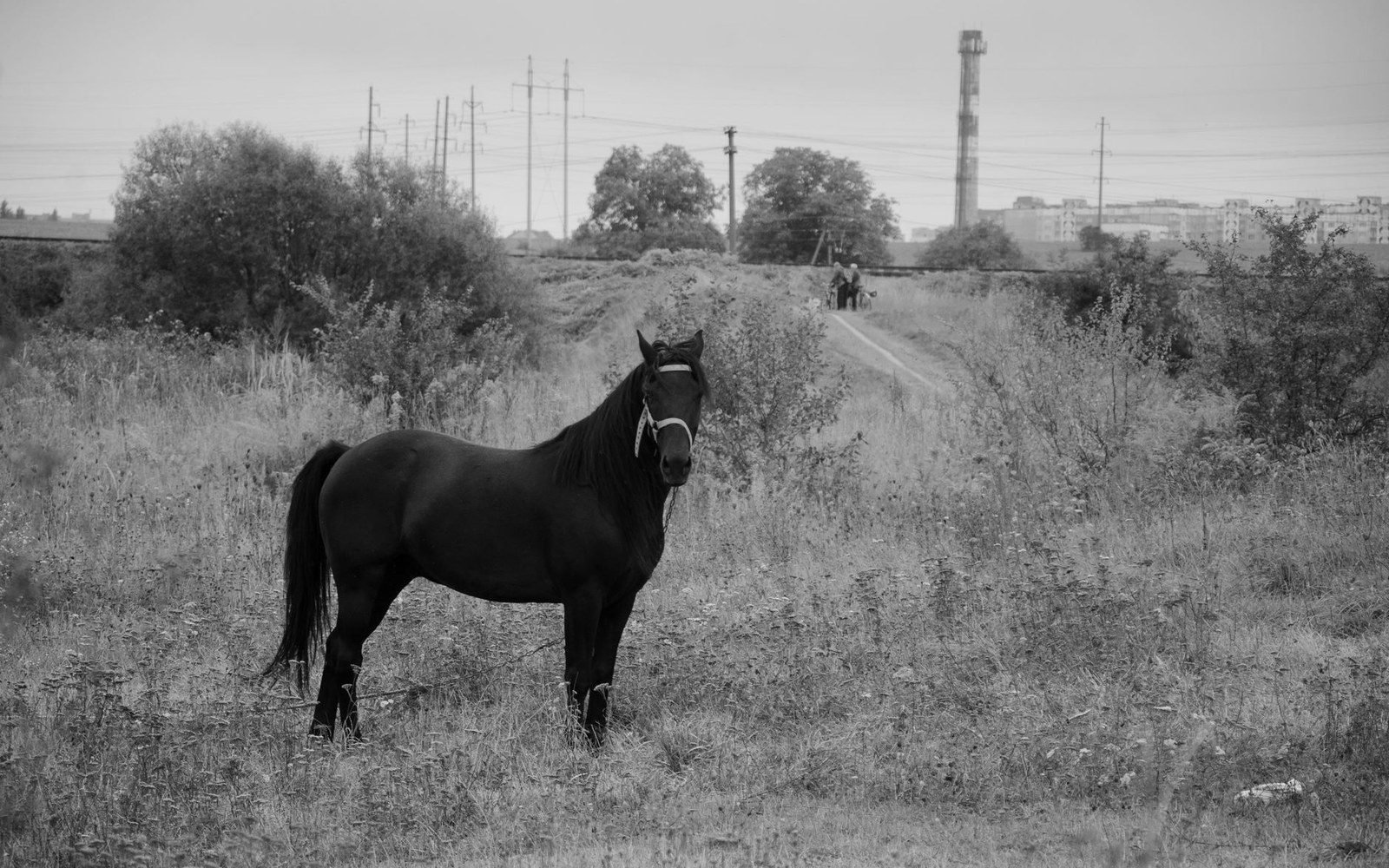
Hard ground produces hard feet. Poor grazing selects for efficient metabolisms. These are not romantic claims; they are the straightforward mechanics of how a landscape, over many generations, refines the animal that lives on it.
Read next