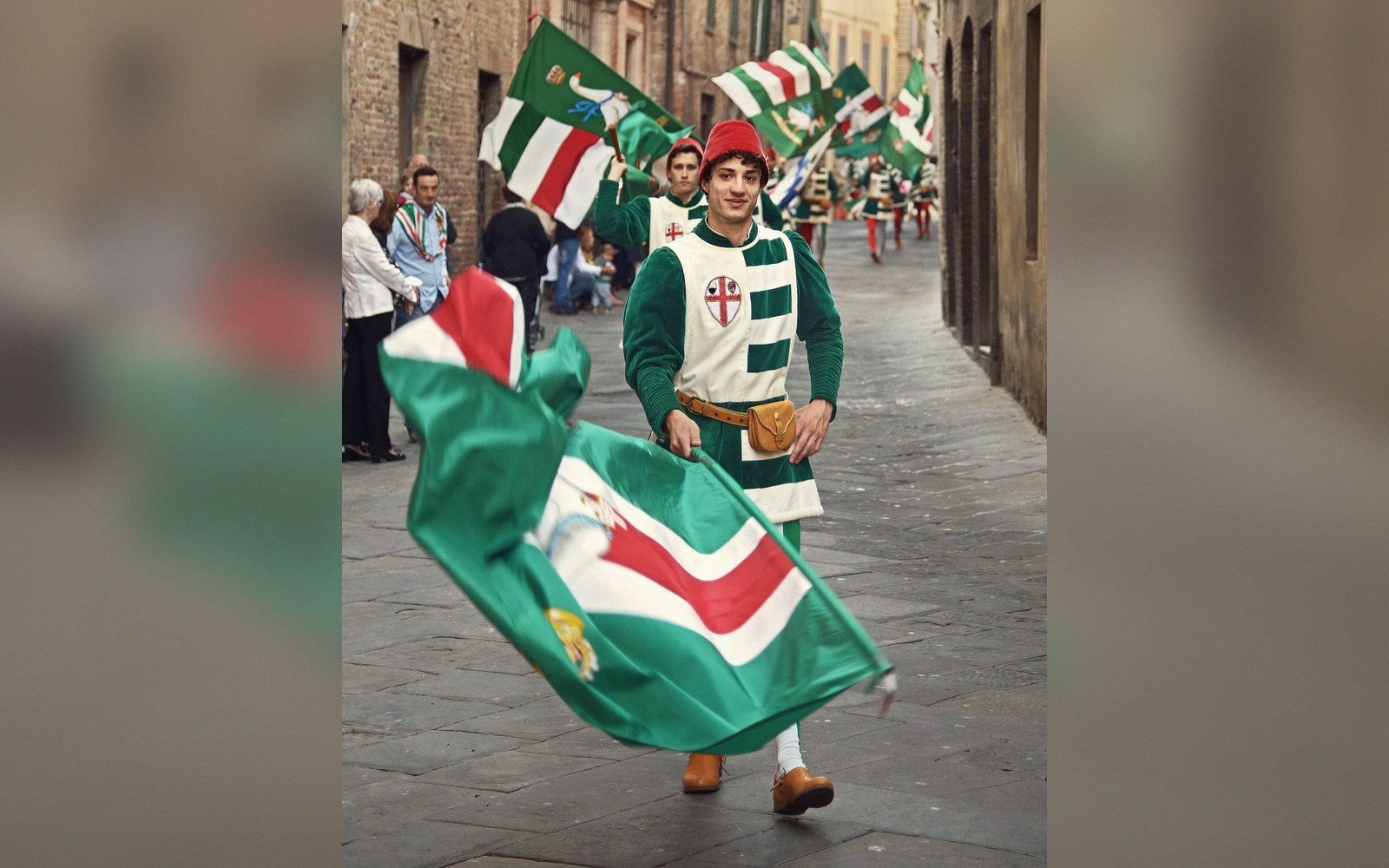
Photo: The procession of the Noble Contrada "Oca (Goose)". Siena, Italy · Wikimedia Commons
Siena is not one city. It is seventeen cities sharing a hill, each with its own chapel, its own museum, its own colours and its own ancient claim to the piazza. These are the contrade — the city wards — and the Palio di Siena is incomprehensible without them. The race lasts roughly ninety seconds. The contrada lasts a lifetime.
Membership, loyalty and the logic of the ward
A contrada is, at its simplest, a territorial parish. Each one occupies a defined quarter of the medieval city, and membership follows birth. A Sienese child born to a contrada family — or baptised in the ward's own fountain in a ceremony called the battesimo contradaiolo — belongs to that contrada from infancy. They will almost certainly die in it. Loyalty is not chosen; it is absorbed. Sienese identity sorts itself first by contrada, then by city, and the emotional attachment is real and persistent enough that adult Sienese living abroad describe themselves by their ward before their nationality.
Siena sits inland on the tufo hills; the square that becomes the track is at the centre of the city.
Geometry: real coordinates, projected
The seventeen contrade take their names from the animals, objects and virtues that appear on their banners: the Aquila (Eagle), Bruco (Caterpillar), Chiocciola (Snail), Civetta (Owl), Drago (Dragon), Giraffa (Giraffe), Istrice (Porcupine), Leocorno (Unicorn), Lupa (She-Wolf), Nicchio (Shell), Oca (Goose), Onda (Wave), Pantera (Panther), Selva (Forest), Tartuca (Tortoise), Torre (Tower) and Valdimontone (Ram). Each has its own heraldic colours, worn by drummers, flag-throwers and riders at every public occasion. On race days those colours saturate the Piazza del Campo in a spectacle that has been continuous, in recognisable form, since the seventeenth century.
Ten run, seven wait
Only ten of the seventeen contrade compete in any single Palio. Seven who did not run the previous race of the same type — the July race or the August race — are guaranteed a place; the remaining three slots are drawn by lot from the ten that ran the previous race. This rotation ensures that no contrada waits more than two years without a run, but it also means that in any given race seven wards are officially spectators — which does not stop them from forming tactical alliances with their favoured runners. The politics inside the piazza before the starting rope drops are as consequential as anything that happens during the race itself.
The assignment of horses adds another layer. After the track has been inspected and the horses approved by the authorities, they are distributed by lottery — each contrada draws a horse, not a jockey. The fantino, the rider, is then contracted separately, often in secretive negotiation that continues until hours before the mossa, the start. A contrada may pay a rider to win for them, or pay another rider not to win for a rival; neither practice is hidden and both are woven into what Sienese call the partito, the strategic dealing that is as traditional as the race itself. The Comune di Siena, which oversees the Palio's formal rules, draws a line at certain interventions, but the partito itself is understood as part of the institution.
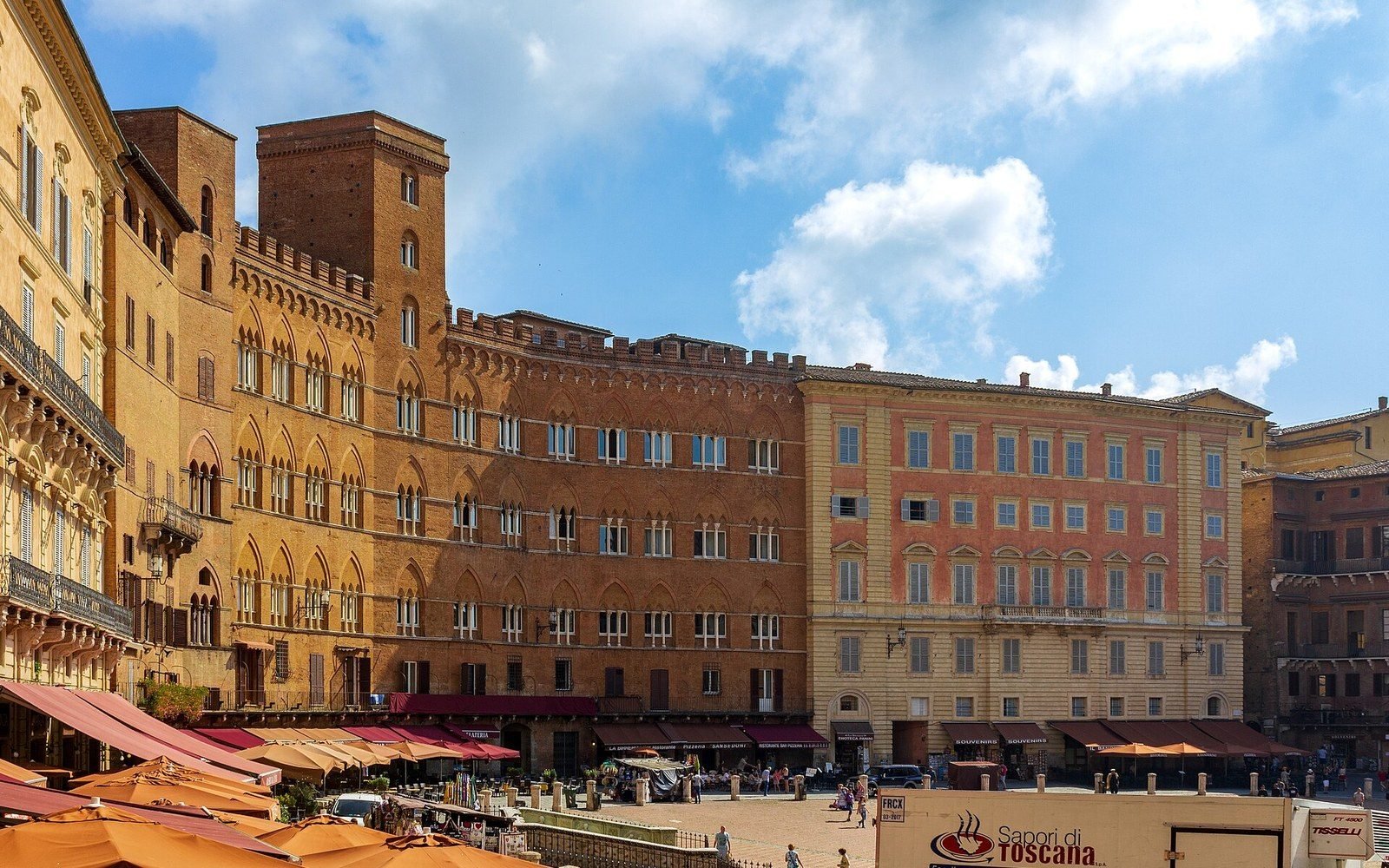
The tufo strip is packed over the brick paving of the Piazza del Campo, used for two days of racing, then removed.
Photo: Piazza del Campo 2014 01 · Wikimedia Commons
What the contrada owns
Each ward maintains a museum housing its historical flags, costumes, trophies and the painted scarves — the palii themselves — won over the centuries. These are serious archives, not tourist displays; the oldest surviving painted silk palii date to the eighteenth century. Many contrade also maintain a social club, an oratory and, in some cases, a stable block used in the weeks before a race when a drawn horse is housed and guarded in the ward. The horse lives in the contrada during that period, fed and watched around the clock, because losing the animal to injury or theft before the race would be catastrophic.
The contrada's chapel is the ceremonial heart of the ward. Before each Palio the horse is led inside to be blessed — a moment of genuine solemnity in a ritual that otherwise mixes religious practice with political calculation and public theatre in proportions that have puzzled and fascinated outside observers for centuries. Whether that mixture is read as a survival of civic religion or as baroque spectacle, it is entirely Sienese, and it is entirely dependent on the contrada existing as a living institution rather than a historical one. The ward is what makes the race matter.
Read next